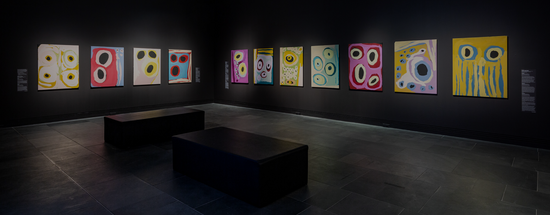
Visiting an art market can be exciting – and sometimes overwhelming. With so many artists, colours, stories and styles in one place, it can be difficult to know where to begin.
Whether you are an experienced collector or considering your first artwork, you do not need specialist knowledge to buy from us.
Ask us about the artwork
Every artist has their own practice, history and relationship with Country. There is no single Western Desert style.
We can tell you about the artist, their community and the development of their work.
Where appropriate, we can also share the public story associated with a painting. Some cultural knowledge is private, and artists may choose to share only part of a story publicly.
In the lead up to a market, the online shop, our instagram, and the artists section of our website are good places to get familiar with our artists, their story and their work.

Behind the scenes at DAAF 2023 | Photograph by Leicolhn McKellar
Unstretched paintings
Many of the paintings we bring to markets are sold unstretched. Rolling canvas is a practical and safe way to transport work over the long distances between our remote communities and major markets. It also allows collectors to arrange stretching or framing to suit their own space.
Before purchasing, we can confirm the painted dimensions, orientation and whether sufficient unpainted canvas is available for stretching. We can also discuss packaging, freight and suitable presentation options.
A professional framer experienced with contemporary Aboriginal paintings should stretch the work after purchase. Paintings should never be folded.
Collecting silks and works on paper
Alongside acrylic paintings, you may encounter works on paper and artist-designed silks.
Works on paper can be an accessible way to begin collecting and often reveal a particularly direct or intimate side of an artist’s practice.
Our hand-painted silks are bespoke fine art pieces. When purchasing one of our silks, we can discuss suitable framing and presentation methods.

Silks presented in lightboxes at Darwin Aboriginal Art Fair 2026 | Photograph by Marley Morgan
Choosing artwork for your home
You can bring a photograph and measurements of the wall where you may place the work. Consider the view from the room’s entrance, nearby furniture and the amount of natural light.
However, try not to choose solely according to décor. Furniture, wall colours and homes may change. A meaningful artwork can remain with you for a lifetime.
Most importantly, choose a work that holds your attention and gives you something to return to.
If you are uncertain, speak with us. We are happy to help you compare works, learn more about an artist’s practice, understand the purchase process and find an artwork that feels right for you.
Buying directly from the art centre
Tjarlirli & Kaltukatjara Art is 100% community owned and governed. We work across Tjukurla in the Ngaanyatjarra Lands of Western Australia and Kaltukatjara (Docker River) in the Northern Territory.
When you buy from us at a market, your purchase provides direct income to the artist and supports the art centre facilities, materials, staff, travel and programmes that sustain artistic practice in both communities.
Our art centres are more than production spaces. They are places where artists paint, share stories, celebrate, sing, develop new work and pass knowledge to younger generations.
Documentation and authenticity
Original artworks purchased from us are recorded in our art centre database and identified by a unique catalogue number.
Your purchase will come with a Certificate of Authenticity which includes:
- Information about the artist
- The artwork’s title, medium, dimensions and catalogue number
- Any public story approved for sharing.
Keep these documents with the artwork. They establish its provenance and will remain important throughout the life of the work.
Buying the physical artwork does not transfer copyright. Permission may still be required to reproduce the image online, in print, on merchandise or for another commercial purpose.
Take your time
We recommend walking through our display before deciding. Notice which artworks make you slow down, look more closely or return for another look.
Try viewing a painting from several distances. Step back to take in the entire composition, then move closer to see the surface, colour, movement and individual marks.
While dimensions and placement matter, the strongest choice is usually a work you want to keep looking at – not simply one that matches your room.