This catalogue essay was written by Riley McPherson for Ngura Palya (Good Country). Cover and artwork photos by 8 Hele Gallery.
Ngura Palya – Good Country
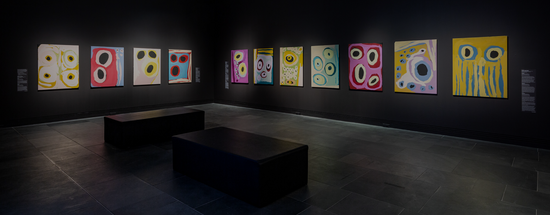
Ingkata Roy Yaltjangki has spent his long lifetime acquiring knowledge in many forms. Knowledge of the bush and hunting, surviving and thriving off the land; of Tjukurpa, the complex layers of law and stories; of Lutheran spirituality and how to serve his community as a well-respected Pastor. The paintings in this show — titled Ngura Palya (Good Country) — embody that knowledge, referencing the country he was born into, lived in and learnt about all his life. Inherent in this learning process is a deep understanding of his responsibility to look after the knowledge of those places, including what can properly be shown and shared through the visual language of painting. He paints in a way that inherently respects the deeper aspects of the stories that cannot be shared, utilising his practice as one way of recording his knowledge and expressing his love of his Country.

Roy Yaltjanki, Photo by Brett Boardman.
Yaltjangki was born in the bush during the Summer of 1933-34 at a place called Arturangu. This site is near Wankari in the Petermann Ranges, a short day’s walk south from present-day Kaltukatjara community. He remembers his early years as an exciting time, nurtured with love and affection by his family at Wankari, the most important water place in the Petermanns during droughts. He watched and learned about the multitude of bush foods his mother and elder sisters gathered and prepared at camp, the different animals his father and the men hunted, and the many places with water in the surrounding country. These were green times: the country was looking good, and Yaltjangki fondly recalls eating copious sweet nectar from the flowering plants on the freshly burnt sand plains. He was starting to get a good idea of how to live well in the bush, learning to make and carry his own little spears and going on adventures to hunt sand goannas and rabbits with his friends and family.

The 1930’s was a time of ever-increasing cultural contact between Anangu families living a traditional life in the Petermann Ranges, and a variety of Europeans. These were mainly miners, dingo scalpers, and missionaries who intermittently came and went for their own purposes, particularly after the passing of Lasseter in early 1931. In turn, some Anangu Pitjantjatjara people, continuing to follow the network of traditional paths for their own purposes, primarily family, ceremonial, and curiosity, were becoming increasingly familiar with some of the many whitefellas living on stations in northern SA, across NT towards Alice Springs and beyond.

In 1938, when Yaltjangki was still a small boy, a group including Lutheran Pastor Albrecht from Hermannsburg Mission came to the Petermanns to make contact with Anangu. Yaltjangki’s father met them at Ururu, a waterhole not far from Wankari, and was told about plans to establish a Pitjantjatjara peoples’ mission and ration depot at Areyonga, around 500km to the northeast. The following year, World War II started. Yaltjangki vividly recalls the extraordinary and terrifying sight of war planes flying in formation over Wankari on their way north.
When he was about ten, his mother and father decided, following investigation of the missionaries’ plans, to take Roy and his siblings up to Areyonga. This was an epic journey on foot of some 500 kms via Lake Amadeus, Purku and Watarrka (King’s Canyon). The group arrived safely in late 1943 to the overwhelming joy of their relatives already living there. It was a completely new experience for Yaltjangki. He went to a European School and church for the first time. He learnt about very different foods like bread, sugar, tea, and other rations. He lived with his family here during his teenage years.
A few short years later, in around 1950, he was considered ready to return to his country to continue his cultural education. Guided by his elder brother-in-law, he and a group of similarly older teenagers walked back to Kaltukatjara and Wankari to be taught ‘everything’ — all the necessary skills to become fully self-reliant in the bush in preparation for becoming a man.

Yaltjangki continued to live a colourful life, travelling back and forth across the Western desert through the many phases of his life, but it is these early years which he draws upon for his art practice. His paintings convey a vision of the special places in this country as he saw them and came to know them as he was growing up: beautiful, unique, profound, and full of life and stories. These places have always been important in his life, and his understanding of them is unique in its breadth and depth. He combines recognisable references to topographical features — the Petermann Ranges, ghost gums, and blue skies — with strongly iconographical circular forms, surrounded by a thick impasto of dense, layered dotting. These sections of landscape and abstraction often appear in the same painting, disregarding literal depictions of Country in lieu of a more complex and intriguing understanding of the land and Tjukurpa. The dotting in vivid tones of glowing gold, warm red, dusty pink and clean blue convey the abundance of this Country as it appeared to Yaltjangki in his youth, providing sustenance and joy to him and his family. The thickness of the punu application serves the purpose of obscuring the many layers of knowledge which rest below the surface of the canvas. Often, Yaltjangki builds up detail in his paintings to such a degree that they can be almost three-dimensional by the time they are complete.

While Yaltjangki sporadically engaged with artistic pursuits in earlier years — notably carving punu for Maruku Arts & Crafts — in 2023 he began painting every day at Kaltukatjara art centre in Docker River. At this time, he was over ninety, joining a contingent of Indigenous artists who came to painting in old age, grounding their work in a lifetime of cultural knowledge and oftentimes freed from self-conscious attempts to legitimise their work through recognisable modes of expression. From open until close, Yaltjangki sits and steadily paints, often singing and humming, rhythmically applying paint to canvas. Commencing with the area of his birthplace, he has worked outwards geographically and conceptually to create a network of maps. This incredible concentration on the specificity of place is at the heart of these works. He has methodically depicted the places which matter most to him, embedding and preserving layers of knowledge into the works themselves. We are thankful to Ingkata Roy for choosing to share the story of his life through painting and inviting us to access, in some small way, the profound love and beauty he finds in these special places.
Access the full catalogue with the works.